Monday, March 22, 2010

LA Story: SCMS Conference Wrap-Up, Digital Narrative Highlights

Here is my highly subjective report from the SCMS (Society for Cinema & Media Studies) conference in LA. Hearing and seeing the producers of the tv show Lost, Damon Lindelof and Carlton Cuse, on a panel on Transmedia was incredibly cool, and meeting them afterwards was amazing. Talking to the showrunner of syfy's Caprica, Kevin Murphy, about virtual worlds after he was on a panel about writing, was another highlight.

All three--and the others who were on these panels--highlighted the importance of storytelling, and for us in Digital Narrative, the story is what it boils down to, as well, because the form or technology, in the end, is not what is primary, is not the thing that drives the audience, but the story. In the industry, the tv show or movie of the franchise is called the "mother ship" and they see it as always being more important than the other transmedia components, whether it be a website, game, or Alternate Reality Game. In the example of Lost, Carlton Cuse used the metaphor of the show being the cake and the mythology being the frosting, but that a lot of people were interested in the frosting. But, as Damon Lindelof said, Kate and Sawyer don't care about the Hanso foundation, and they couldn't tell that backstory in the show itself in great detail, but they could in the highly successful ARG. The other platforms become ways to tell other stories, related stories--and note that they are still talking about STORIES.

Kim Moses from the Ghost Whisperer talked a lot about giving the viewers an experience --a "total engagement experience" that would be like a playground that would extend the show and then gently bring viewers back to the show, creating more loyalty and emotional investment.

There was also discussion of "monetizing" the other platforms, but this wasn't the speakers' primary focus in this forum, although I bet it is in others :) Lindelof, Cuse, and Javier Marxuach, who worked on the Lost Experience ARG, all talked about trying to incorporate sponsors and how difficult that was, and that ultimately what the ARG did was to keep the buzz alive during the offseason, which is nothing to shake a stick at, but maybe is not quantifiable. People also filled out contact information when they signed up for the Hanso Foundation, and so ABC has that information--isn't that a valuable asset, they wondered?

In the question and answer part, someone asked a leading question, based it seemed on his theory that in the future the ancillary media would overtake what the producers were calling the "mother ship" of the franchise, the movie or the series that spawns all the other stuff. The producers were incredulous. Someone, I think it was Lindelof but maybe it was Marxuach (it was hard to see and they were both so quick and witty) said something like "No way am I going to do homework to go and see Batman." Later someone connected it back to storytelling, to being told stories rather than playing a game, or doing a puzzle, really, to that kind of entertainment driving the big money and resources of the industry. It is a pretty interesting thing to think about, esp for us in this class. What place does interactive narrative have? How much agency do people want? Is it a story or an experience? Is a game also a story, or is it something different? Does it matter where on the paidia to ludus continuum the game is? How much agon, alea, mimicry, or ilinx? (Remember all of this from Caillois?)

This brings me to the really fascinating conversation I had with Kevin Murphy, who joined Caprica as a producer to work on the second half of the first season (ie: brought in to address some perceived deficit) and then replaced the showrunner a month later in November 2009 (the series premiered in January 2010). I wasn't interviewing him (or Cuse or Lindelof when I talked to them, either), but wanted to say hello as a fan and express how much I love their shows. We got to talking about virtual worlds, and I said I had been doing research in Second Life, making machinima, etc, and that I thought that part of Caprica was particularly interesting albeit an incredibly negative portrayal of a virtual world--all sex and violence and transgression without consequence. He said that there was only so far they could go with the narratives in the virtual world because the characters couldn't change the virtual world, basically didn't have agency within it, unlike the actual world. This is so fascinating--the way that the v-world in the text of Caprica is set up in their story limited their story, because it is not open-ended like Second Life with a high degree of agency, but more of a closed game. Zoe is a character who lives in some weird form in both the actual, physical world, but as a robot, and in the virtual world as an avatar, and nowhere and yet kind of in both as the young woman she once was. Her friend, who is dead in the actual world and exists only as an avatar, with no robot component, is even more intriguing, and a fictional realization of the idea of downloading the consciousness of someone so they can live on after death. The v-world storylines could explore the ideas of identity and avatars--of action and consequence--that are so fascinating. Which is more "real"--the robot, with its BSG red eye, or the avatar? What does it say to choose the robot over the avatar, if that is how the show is going to go, and that is how Murphy made me think the show is going to go. (And that is how BSG makes it seem like it has to, because as much as there is the level of the Six in Baltar's head, as much as the Cylon seem to live in what we can think of as an augmented reality by the end of the series, it is a visceral, physical, embodied reality that BSG excelled at).

Here is the information on the two sessions, both organized brilliantly by the Television Studies Scholarly Interest Group, who really delivered in these and other sessions for this conference:

The More Things Change…
Writing for Television in the 21st Century

Chair Sharon Ross
Columbia College-Chicago

Neal Baer NBCUniversal
Lisa Seidman NBCUniversal
Mark Brown WGA
Kevin Murphy Syfy
Noreen Halpern E1


Transmedia Studies
The Hollywood Geek Elite Debates the Future
of Television

Chair Denise Mann
University of California, Los Angeles
Co-Chair Henry Jenkins
University of Southern California

Carlton Cuse LOST, ABC
Tim Kring Heroes, NBC
Javier Marxuach DAY ONE, NBC
Kim Moses Ghost Whisperer,CBS
Mark Warshaw Alchemists
Damon Lindelof LOST, ABC

OTHER COOL THINGS at the conference:

There were some good sessions I went to, in particular, one on the museum and new media, and another on historicizing video games.

AND although my book I Love Lucy does not come out until April 15, there were copies at the conference at the Wayne State University Press booth, and for the first time, I held it in my hand (see below), cementing the place of the physical, actual, material object in its place in a hierarchy from which it will take an awful lot to dislodge. Read more about my book here.


Thursday, March 11, 2010

Defining Play & Games: Caillois

Agon, Alea, Mimicry, Ilinx: these categories of games that Roger Caillois isolate different aspects of play as they are codified into games.

Caillois defines Paidia as the "spontaneous manifestation of the play instinct" that leads to turbulence and disturbance. Ludus is the "taste for gratuitous difficulty" (141).

Let's apply these terms--and check back to Caillois's revision of Huizinga's definition of play (see below, p. 128) as we discuss your excellent analyses of the games you play and of some that we play together.

Wednesday, March 10, 2010

Analysis of Two Games


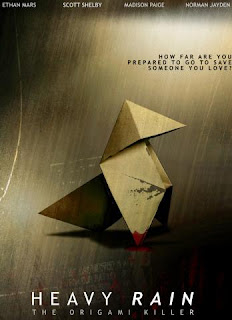
Game Analysis - Heavy Rain (Playstation 3)

The first game that I am analyzing is the recently released Heavy Rain for the Playstation 3.

Heavy Rain is not a game that can be easily classified, but I will do my best to explain the premise. Essentially, it is a cinematic murder mystery thriller that portrays the story of four central characters who are in some way connected to one another. The goal of the game is to find the "Origami Killer" who is a serial murderer that has, in one way or another, affected the lives of our four heroes.

The game takes place in the third person, with a "third person limited" point of view for each character. I say this because you can quite literally hear the thoughts of the character you are controlling with a simple button press. This works well for a game that is entirely focused on character development and plot.

Speaking of simple button presses, that is all there is to the actual playing of this game. Now, in my opinion, that does not discredit it in any way. To show you what I mean, I think it would be easier to show a video clip of the game in action:

Note: Do not read the text comments for this video, as many people try to intentionally spoil this game for others.

http://www.youtube.com/watch?v=mQKLwLxe5-M

As you can see from this video, all interaction in this game is done with timed button presses, also known as "quicktime events." The player can fail in doing the proper button presses, but instead of a game over screen, the game continues on. No matter how many times the player succeeds or fails, the game will continue. Depending on how well you do in each segment, the story will change drastically.

In terms of self-design, the characters in this game are already pre-set and you cannot change their appearance or mannerisms in any way. But what you can do is make a vast amount of choices that effect the way other people interact with them, how the world at large views them, and how the tale itself plays out, which segues nicely to the next point about social interaction.

Social interaction in this game is played out just like the rest of it, which is to say, through quicktime events. When prompted with something to say, the character you are in control of will have a list of things he/she can say to certain people. How you choose to speak to people determines how they feel about you, which may lead them to showing up later in the game to help/hinder you.

On the subject of space and place, this game does not really garner a sense of topophilia, as it takes place in a generic American metropolis where none of the areas are particularly distinct, but to the game's credit, what takes place in each of these locations is incredibly interesting.

Although you cannot physically effect the world like in Second Life, the world can and will change depending on the choices the player makes. Seeing as how there are only a finite (albeit large) number of choices that can be made, the level of virtual agency isn't incredibly high, but still quite respectable for a single-player game like this.

Game Analysis - Demon's Souls (Playstation 3)

The second game I have chosen is Demon's Souls for the Playstation 3.

Unlike Heavy Rain, this game can be easily classified. This game is a third person action game that takes inspiration from gothic Western fantasy influence. As you can tell from the title, you are mainly battling demons.

This game uses the third person point of view like many action/adventure type games do. Unlike Heavy Rain, there is no personal character development in this game, as you create your avatar. Your character never speaks, and has no personality of his or her own.

One note about this game that I would like to mention, is that it is known as "the hardest game ever". While I don't quite agree with that, this is indeed one of the most difficult games I have played in recent memory.

This game is based entirely around combat, and this game in particular has a very simple combat system of using light, and heavy attacks with a button for magic. The difficulty in this game comes from the fact that you collect "souls" when you kill enemies, which are the currency of this world. If you die, you lose all of the souls you have collected up to that point, and have to start the level over again. If you can reach the spot that you previously died at, you can regain your souls, but if you die when trying to retrieve them, all those souls are lost forever.

On the subject of self-design, this game allows you to create your own character from scratch with a very robust character creator. Once your character is created you can choose to be good or evil by your choices in the game itself. Being good tends to make the demons you fight weaker, while also making them drop more healing items. The downside to this being that this makes the demons drop less souls. Being evil does the opposite, the demons are much stronger, and drop almost no healing items, but they tend to give more souls, which, again, are the lifeblood of the game.

Social interaction in this game is quite interesting, to say the least. Although this game is mainly a single-player game with little to no interaction between the in game characters and yourself, when you are playing this game, it makes a point of connecting you to an online server. Once you are connected you can write messages on the ground, which can be seen by other people on the same server. For example, you can write down things such as "use fire on the next enemy" or "there's a fall ahead" to warn others. Now, the interesting part is the fact that you cannot see anyone else who is playing on the same server, even though everyone can see each other's messages. Once you advance further in the game, you can invade other people's worlds to either help or hinder their progress as you see fit, which will turn your character to good or evil depending on what you choose.

When talking about space and place, this game has a very unique gothic world which I do enjoy. Although I am not very emotionally invested in it, it is a very beautiful and dark world that invokes a good sense of wonder and amazement when setting your eyes upon it.

In terms of virtual agency, you cannot really effect the world in a very meaningful way like in Second Life, although you can choose which of the characters you encounter lives or dies, which does not effect the world in a very significant way.

Game Analysis: Part 2 - DJMAX

I was a little reluctant to select this as my second analysis on the count that it's hard to discuss subjects like narrative, immersion, interactivity, social networking, etc in what is essentially a rhythm game with the simple objective of "do stuff according to a beat". But I guess that when contrasted with the prior analysis of WoW, the dichotomy is just all that more pronounced.

Of course, as a music student and future professional musician/producer/composer/whatever along with being a hobbyist video editor/compositor/art junkie, the production value of the media presented in the DJMAX franchise is also an awesome entertainment experience, and a really welcome breath of fresh air compared to the loads and loads of garbage MTV is feeding kids these days.

DJMAX today exists in three forms - a (semi-abandoned, unfortunately) PC game, a series of PSP games, and an arcade machine. The two former are extremely similar in the sense that you hit buttons in time to falling bars to 'fill in' parts of a song. The latter, while sharing the same songlist generally, is a somewhat different experience as the player instead touches a touchscreen according to the timing of a line that moves across the screen. Play is judged based on accuracy and consistency, and global internet ranking exists for all the games.

I guess that if the player were to assume a role, he'd be playing himself/herself in the shoes of a virtual DJ (for the lack of a better analogy) although I find this far less pretentious than Guitar Hero and other similar western music games. (Speaking of which, this is a little nitpicky but Japan and Korea have been making rhythm games long before Kotick ever assumed his position of HIGH HORSE EXTRAODINAIRE at Activision so it's pretty hilarious watching idiots comment on DJMAX, IIDX and other older Asian franchises as "guitar hero clones")

The above idea, that you can be whatever you want just by believing, is personified by the first PSP game's intro movie (which also doubles as a playable 'theme song' for that particular game in the series) which depicts a schoolgirl's aspirations to be a pop star. This is built upon in the second game, where the lyrics to its theme song/intro very obviously carries that train of thought further.

Despite the game's club-suggestive title, and despite the fact that quite a bit of the soundtrack falls solidly under the dance genre, the franchise is reknown in its circle of fans for its extremely diverse yet almost universally catchy and/or moving music. Here's just a (unfortunately very brief, trust me!) rough cross section of the genres represented:

Proposed, Flower, Wolf - Piano Ballad (this should be somewhat familiar!)
Proposed, Flower, Wolf pt2 - Orchestral/Violin Filmscore-esque
Eternity - Rock Ballad
Keys to the World - Modern Rock
In My Dream - Metal Fusion
Here in the Moment - Latin Fusion
Mess it Up - Electro Big Band/Jazz
Right Now - Gospel Ballad
Hard to Start - Chiptune (YES!)


What sets DJMAX apart from other music games is the amount of work put into each song especially in terms of its accompanying visuals, as you may have noticed from the above examples. The art jockeys are arguably as important as the composers in content development. You could say that each song has a story to tell, whether it's lovers meeting on the beach, A gender-bending parody of Sherlock Holmes, zombie apocalypse, Vandread spinoff, one of those FIGHT.gif things, gun-toting, racecar driving, femme fatales, superheroes that power-up to beat up couples (HAHAHA) or simply more abstract pieces with no real story, the list just goes on and on and on.

I can safely say that the franchise has opened up my tastes to a lot of different genres of music (and I'm a better person because of it) and challenged me both rhythmically, and interestingly enough harmonically when trying to understand what goes on in some of the songs and how they evoke the emotions they do. In fact, this niche genre where music and gaming intersect is one of the big reasons I took the plunge and moved across the globe to attend Berklee rather than staying in my little hole back in Malaysia.

Before I forget, here are a couple of vids of what actual gameplay is like: in PSP form, and the arcade machine (speaking of which, college really needs to buy a couple of these. I'll save up quarters >:V )

Subjective Analysis of Two Games


For this project, I will be taking a look at OMGPOP's "Draw My Thing" and "Sims 3" from EA Games.

To begin, omgpop.com is a website that hosts multi-player games in a social online environment. It has a built in user profile system similar to Facebook. You can check what games your friends are playing, see your recent list of opponents, send challenges to other players, and see what games are most popular and who is playing them.

The site has it's own currency, which you can earn by logging in daily, winning games, betting against your opponents, watching ads, or answering survey questions. Of course, with this collectible currency comes one of the most addicting features of the website: customizable content. For every game there exists customizable characters, items, power boosts, etc... Focusing on "Draw my Thing", players can customize their writing utensil, clock timer, and even by vowels to get a jump start on their opponents as they scramble to guess what each other is drawing within 60 seconds. Sounds familiar? With a very sleek interface and a booming social network, omgpop has made online Pictionary and other simple games seems new again.

Omgpop's interface is as simple as can be and just the way we like it. Instead of listing games down the page with small icons like Kongregate.com, Armorgames.com, Newgrounds.com, and many other still do, Omgpop's aesthetic seems to borrow from the glossy sliding frames of the iPhone and similar Apple interfaces. As a testament to how alluring the interface is, several times since trying to write this analysis, I've been watching the billboard that scrolls through their games and have gotten sucked into playing them multiple times. It's hard to leave this site once you enter.

Moving on to Sims 3.
My girlfriend got me hooked on the Sims 2 earlier this year. It was so easy to spend hours building elaborate mansions or decorating a house with quirky materials. The ability to create in the Sims only grew as EA very cleverly allowed user generated content to play a big role in the game. "Why not let them do our job for us, and they can make whatever they want and be happy!" Same basic principle to Second Life, of course its easier to create in SL than it is in the Sims.

Sims 3 was very hyped and highly anticipated. I was hoping it was going to be leaps and bounds ahead of Sims 2, but in some ways, it was even worse. EA may have been depending on user generated content a little too much this time around, and skimped on some critical building tools. The overall building engine and graphics are very similar to how they were before and the only new "big feature" was that you could now place objects on a 45 degree angle... Yippee!
In the trailers, the cameras were all positioned closer to the characters and lower to the ground which gave it a much newer look. I was disappointed to find that the camera still really only functions in bird eye view, and trying to zoom in just results in the camera jumping around everywhere.

On a positive note, I was able to get more involved in self-design in the Sims 3. The characters have more flexable facial features and there's some decent user generated content to download.
Having more control in character creation has always helped me get more attached to the character and more involved in the game. Unfortunately, the Sims 3 still doesn't keep my attention as well as it should for a highly anticipated release in this age of gaming.

After I was playing for a while, I noticed something about the game play was bothering me. I didn't know what it was, but I almost was feeling sad when I was playing. I eventually realized that the entire game felt incredibly lonely, a giant world with lots of characters that just did everyday things like me, and they weren't even real people. I'm starting to think that this format is not working as well as it used to for the Sims, especially when there are better games out there that have an online social capability. I was less interested in clicking on a person and saying "tell joke" when I could go online in Second Life and do it myself. I think if EA is going to survive another Sims game, it has to be like Sims online.

From my perspective, it seems that social interaction is becoming more and more important in gaming. Don't get me wrong, I love a good RPG with some good character writing for NPCs, but if the story isn't well written and immersive, the game can seem a little lonely next to some games with bustling online communities.

Critical Analysis of Two Games

The First Person Shooter
Modern Warfare 2 and Bioshock 2 are both first person shooters and they are both recently released sequels to extremely popular games. But this may be all they have in common. Contrary to popular belief, first person shooters are not all the same.

Modern Warfare 2
Modern Warfare 2, set in the modern day, takes us to various places all over the world. As in it's predecessor, there is not a single point of view of the story (although always first person perspective.) The player is continually changing character from mission to mission which makes the story a little harder to follow. And once again, as in the previous version, your character dies. As the game progresses and the points of view converge, it seems almost like they are changing characters just for the sake of it, which becomes distracting.

The action packed missions are pretty straight forward: shoot, kill run, etc. There is a lot of automated interaction with the other AI characters when tasks are completed. But there is no user initiated interaction necessary to play this game. The various settings are realistic enough, Rio, Afghanistan, snowy Russia, to name a few, as well as the infamous airport.

While playing this game I accepted the virtual world it provided me, enjoyed the realistic warfare, didn't mind mercilessly killing everyone in sight. Until I got to the airport. The place is packed with everyday people waiting to take a flight somewhere, and you are supposed to mow them all down. They don't have guns, they can't fight back, they plead for their lives, they panic. It was way too real. People in airports are going on vacation, going to see family, going home. Nothing came out of this, it was gratuitous and unnecessary, I felt dirty, it totally took me out of the game and kind of pissed me off. I am all for pushing the boundaries and testing the limits, but this is not what I shelled out 60 bucks for.

On the other hand, the online multiplayer is where it's at. Playing with friends is what this game is all about, and worth every penny of the money I spent. The voice chat is great, but Activision blocked XBOX party chat for some reason, which can get really old when a bunch of annoying kids are in your match.

Bioshock 2
Bioshock 2 is set in an alternative version of the 1960's in a fictional underwater dystopian city called Rapture. Unlike it's predecessor, this time around you are a Big Daddy, which was the enemy in the original but is the good guy in this installment. The story unfolds through a combination of PA broadcasts and diaries you find and have the option to read or not. As the game progresses the story becomes clearer and clearer.

The environment is well made and stylized to be creepy but not overly realistic. The poor lighting and creepy music keep the player captivated, always peering into the shadows to see what is lurking. The baddies come out of nowhere suddenly (and have made me jump a few times), which is key to maintaining player interest.

There are lots of things to interact with in this game. Items to pick up are littered all over the place including weapons, powers, health, food, and even booze. Dispensers of the same objects can be found frequently, and you have the option to buy items or attempt to hack the machine which brings up a little game. Distractions like this within a game help break up the monotony, but I love that the player can bypass them with cash.

The Little Sisters are creepy little possessed girls with powers, and you have the option to save them (make them normal again), or harvest the (kill them and take their power). At first I felt bad for them and opted to save them, but I realized I got more when I killed them so that became the routine.

Bioshock 2 has an online multiplayer feature, but I have not tried it. I don't really know anyone who plays Bioshock online, we usually play Modern Warfare.

In Closing
Modern Warfare 2 is more realistic, straightforward and action packed, but the line between real and fun was crossed which left me with a bad taste in my mouth. The story was also confusing at times and the constant changing of character disconnected you from the experience. The online multiplayer is awesome and leaves all other similar titles far behind, sorry Halo. Bioshock 2 is not as fast paced, but the environment is much more captivating and the story more coherent. The user interaction with objects and machines was also appreciated, as it gave the game another dimension. The fact that I felt no remorse killing little girls to gain power, but was upset at having to kill defenseless civilians in an airport may seem odd. But I wonder if I would have happily mowed down the civilians if there was something to gain or any sort of point to it.

Short Version:
-Constant change of character in MW2 leaves player feeling disconnected
-MW2 airport mission too realistic and gratuitous
-MW2 online multiplayer is awesome
-Bioshock provides a great virtual environment via graphics and sound
-Interaction in Bioshock adds another dimension
-Don't know anyone who plays Bioshock online
Game Analysis: Part 1 - World of Warcraft
(If there aren't any glaring objections, I'd like to take this assignment in multiple parts, as 1) I do have quite a bit to say that may not be obvious at first glance due to the way I play games, and 2) I really, really, loathe when I type up a cartload of stuff and have the page 404 - I've developed a paranoia of that over the years)

First of all, let me say that I'm glad that we're talking about subjective experiences in games, because due to my somewhat eccentric, OCD personality, my experience with any form of entertainment is pretty atypical.

I think that it is impossible nowadays to speak of digital narrative and social/virtual interactions without reference to MMO games, and World of Warcraft (Blizzard, 2004) in many aspects represents the epitome of the genre, standing head and shoulders above all the competition, past and present (many of which ironically coined themselves 'wow killers' only to get curbstomped by reality) in both subscription numbers and content.

The cool thing that Blizzard has done with the game is that it has something for everyone, whether it be competitive gaming (many will laugh at this one, me included at times), casual gaming, role-play, simple objective completion, making virtual profit off the infamous Auction House/trade channels, or simply just enjoying a good tale. And all this is tied together by the fact that the game is a huge social circle - people of all the aforementioned walks interact with each other on the same (four-hundred-odd) realms.

WoW's general backbone experience is: levelling, and the game at maximum level (currently 80) which many will argue is where the game really begins.


The Narrative
World of Warcraft is (obviously) based in the Warcraft universe, which started in 1994 with the RTS game Warcraft: Orcs and Humans. The underlying story which is the brainchild of Chris Metzen has gone several overarching reiterations/retconning, although by the time Warcraft III (2002) rolled about, the universe was rich and stable enough to support all kinds of tangents and canonical spin-offs - as of now we have comic books, novels, and of course, in-game content delivered through the WoW platform, all giving glimpses into Metzen's universe.

From the exploration of the homeworld of the Orcs (original storyline is Orcs invading the Human world) and what drove them on the warpath, to the elemental mysteries of the land Warcraft takes place in, to kingdoms new, fallen and long gone, to villains past, present and future, to the ethereal 'emerald dream', Metzen's universe is currently large enough to fill up a dozen seasons of TV series, with enough heroes, villains and noteworthy characters in between to fill up several virtual museums.

The player is presented bits and pieces of the story through quests, various readable knicknacks in cities/libraries/dungeons, recently in-game cinematics, and of course, the timeless process of hands-on whoop-the-bad-guys'-asses action in dungeons (and larger, harder dungeons, called 'raids' - more on that later). The amount of story that is crammed into the world that has little to do with the main plot is amazing, and a testament to the quest designers' creativity. From the tale of Mor'Ladim (which is a pretty long quest chain ending with the moving defeat and redemption of said character), all the way to tributes of real-life occurences such as Sully Balloo's letter the levelling experience is chock full of narrative that the average player won't find when just rushing to the end.

The latest expansion, Wrath of the Lich King, adds cinematics into the mix. Players are breadcrumbed into eventually facing off with Arthas, a villain from the Warcraft 3 era. In fact, the entire expansion is about Arthas, including cinematics that highlight key points in the story, including his eventual defeat. (spoilers!)

However, an interesting dilemma comes up: When you allow players (<-- note the plural) in a massively multiplayer online game to be the heroes in the story, how do you cater to the fact that there are literally millions of players doing the same thing and reconcile that fact with the need to have a cohesive story? My personal take on it after seeing things unfold is that there basically exists two different versions of the Warcraft story: Metzen's story, which is canon, and does not contradict itself throughout its' entireity, and World of Warcraft's personalized retelling, which is specific to each player that plays the game and while follows the same broad strokes, is not necessarily canon.

For example, let's take Onyxia, a major villain in the original World of Warcraft release. There was a long questline that led up to the eventual face-off and defeat of Onyxia (and back then, guilds who managed to kill her were BAD-ASS) However, recently rewritten lore in the form of the story arc of King Varian Wrynn (published comics) reveals that in fact, it was he and a small band of his friends who ended the threat. Naxxramas, the final raid zone of the original game, was in fact stormed not by players, but by other characters within another set of media.

Basically I have come to terms with the fact that the game I am playing isn't 100% canon, but instead a slightly different retelling via artistic license, in the interest of an enjoyable experience. That in itself is an interesting exercise in non-linearity, when you come to think of it. :V

But enough talk about the narrative, 90% of the people who play WoW don't even care about it - let's move on to what makes people value their characters and what in essence puts the "game" into MMORPG for WoW!


Dungeons and Raids - the Social Requirement

As I mentioned early on, it is very easy to hit the level cap in WoW. The main driving force behind the game is how people 'upgrade' their characters at this maximum level. The game at this point revolves around multiple tiers of 'progression' in terms of your character's gear. The basic premise is that gear from 'tier 5' should allow the average player enough character power to defeat and slowly acquire gear from 'tier 6', and so on and so forth. Every once in a while, Blizzard releases an expansion that raises the level cap and resets progression for everyone by giving e.g. quest items of comparable power to the last tier of the previous expansion.

However, there's a twist to this. First of all, the majority of good 'loot' comes from grouped content, in the form of raids. Raids basically require 25 (or 10 for a watered-down version) people acting in tandem to defeat bosses. The beauty of this is the fact that bosses drop 2-3 pieces of gear, and are generally on a 1-week reset timer. They also have the potential to be soul-crushingly difficult, requiring for example perfect execution over 10 minutes by everyone, or the attempt 'fails'. These two added together lead to the basis of guild interactions within the game.

Basically within the population, groups form up that regularly raid together. Within these groups, trust and camaderie (and often violent, explosive bouts of e-drama) are built, as you eventually learn who is capable of performing during raids, and who's the proverbial deadweight. The simplest premise of this is trusting that the 24 other people (and a few more actually) will log on at specific times so that the raid can actually happen. Social ties are built as guilds share loot and eventually the sense of accomplishment of killing the final boss of a raid dungeon.

Another thing to note is the vast gap of skill level present in the game. The 10 classes available in the game are, despite what a vocal section of the playerbase say, pretty well balanced vs each other in terms of requiring a few in the raid, and the difference between a player who knows what he's doing and one who's clueless is very, very, very, VERY quantifiable. Blizzard generally releases bosses tuned to require at least a certain amount of gear, and knowing how to play can substitute for a lot of that requirement, resulting in earlier kills by guilds who are good enough to pull it off. Hence, the 'competitive' side of the game - boss kill bragging rights, world placings, regional placings, etc.

So Falk, this is all nice and good, (and probably a hilariously Captain Obvious-esque read to people who -do- play WoW) but what about YOUR subjective experience?

Before moving to Boston, I had the privilege of raiding with Tsunami, a guild based in Australia. We were perhaps what you could call a 'world class' guild, competing for world top-20 first kills of new bosses that Blizzard released.

The dynamic of the guild was pretty interesting. Our number one priority was maximizing the amount of return from the investment of our 4 nights a week we devoted to raiding. This meant that if someone wasn't performing properly, they'd probably be out of the raid roster pretty fast. It was almost a professional sports team in terms of expectations. Most of the trials who 'didn't make the cut' understood that the guild wasn't a social guild - you didn't get raid spots or loot just because you were the friend of someone who had already contributed a lot - you had to pull your OWN weight.

You learn that what you want and what the guild needs are often at odds. That piece of loot which may be an upgrade to what you have, may very well serve the guild better in the hands of another that allows the guild to kill other bosses faster (resulting in more loot long term - dice-rolling random nature of loot generation aside)

You learn a lot about accountability, about how to make sure someone can cover your responsibilities should you not be able to be present.

I personally learnt that when playing games at this level, sometimes it becomes less of a game and more of a job, but hey, if it's enjoyable overall, it's enjoyable, right?

Despite the status of the guild not being a 'social guild', social ties were easily formed within the guild. It's only natural when you ride together, suffer together and celebrate together that you learn to trust. It was at the point that we'd be able to mostly trust each other with account logins should someone be required to attend to something on a particular night (Hey, being a WoW nerd is only a ticket to skimping -so much- of real-life activities!) A bunch of the guild met up at the end of last year to hang out, from all parts of Australia.

It's kinda cool thinking about it - latency from Australia/Asia to our WoW servers (based in LA) was nothing to joke at. We'd wrestle with connectivity issues that most American guilds never dreamed of. We raided 4 nights a week on a progression cycle where guilds at our level of progression usually go for 5 or even 6 nights a week, and we still manage to do pretty well in relation. One of the last major progression cycles I participated in (before preparing for Berklee consumed my time) resulted in Tsunami claiming Oceanic First for Algalon, one of the 'trophy' bosses of the time. (That video is me playing, btw. It may look simple, but it's not! But going too far into game mechanics will make this aberration of a post even longer than it already is)


The OCD Factor

I'll be honest. I have a near-autistic completionist tendency for certain things in life. Doing things in WoW was a big sate to that thirst over the course of a few years. There's a saying 'if it can be done, someone will do it' and that was my motto for WoW. From reputations (Most of which give no benefit whatsoever) to my ridiculous urge to complete every single quest available to me in the game, I chipped away at it all.

In Wrath of the Lich King, Blizzard implemented an Achievement system - little things that ranged from getting a haircut, to reading certain books in the game, to collecting a set number of pets, to doing ridiculous red-herrings during boss encounters, which was all recorded. This sent me head over heels, because now I had EVEN MORE THINGS to complete!

It made me stay up for ~56 hours straight (only with a 2 hour nap near the end) to level from 70 to 80 as the game launched, letting me claim the Realm First 80 Server First 80 feat of strength (of which, obviously, one person per realm ever gets). For the record, WotLK launched on Thursday, and I -did- attend college on Friday.

It sent me back over all the territory I'd explored previously, leading to discoveries of things I never knew were in the game. It made me reevaluate certain things and come up with creative solutions for feats that usually would require more than one person to complete.

It made me wake up at odd hours of the night to scour the continents for rare mobs that would spawn once every ~6hours to a week to tag and kill them - And what a sigh of relief when I finally crossed that last one off the insane scavanger hunt, 2 weeks after I'd found everything else. I hate my luck.

It finally gave me a title (fittingly enough, "the Insane") for having a bunch of exalted/maxed-out reputations that I'd worked on years ago. Finally, due recognition for my autism! For posterity's sake, one particular faction required an extremely unconventional method of collecting and turning in "Darkmoon Decks", of which most people collected maybe one in their entire life to turn in for a trinket. Over the course of 8 months I filtered the servers' economy with a fine tooth comb, scouring the Auction House almost daily for the things I needed. Over the course of 8 months I built 108 of those damned decks, and all for... an exalted reputation no one even cared about.

That was only one of the factions. Another required pickpocketed lockboxes - about 2700 of them, and you could only pickpocket (with a 1/10 chance per mob) with a Rogue which I levelled to 70 just for that purpose. His name is aptly "Boxcollecta". There are other factions involved of course, but let's not even start talking about those.

Sometimes I look back and I wonder if the hair loss was worth it. ;p In a sense, it was - that particular feeling of accomplishment I got when I finally stood in front of that Darkmoon vendor, turning in all the decks in a way that was never intended by the games' designers, finally reaching a goal which after 2 months in looked like an impossible task. I guess I taught myself a lot about patience and perserverence in the process.

After coming to Berklee, I guess I'm nowhere near as hardcore as I once was. I'm still in Tsunami, but the raid times are a little prohibitive (3am Eastern... hmm) so I'm unsure what I'll do with the character. I'm definitely not selling though - I'll never understand people who can take that plunge and part with their characters, even if they'll never play them again. I guess I have a somewhat sentimental attachment.

If you've read up to this point, I'd like to congratulate you on being able to survive reading about my highly subjective experiences and analysis of the social stigmas surrounding World of Warcraft. I hope you aren't at this point as bald as I am and I'll see you in part 2 where I analyze yet another game and take 8237482374 pages too many to do it.